Want your YouTube videos to get more views? Here’s what you need to do right now to make your videos easy to find:
Quick Action Steps
- Write a clear, interesting title with your main keyword
- Create a detailed description explaining what your video covers
- Add 5-10 relevant tags to your video
- Make an eye-catching thumbnail image
- Add accurate captions or subtitles
These five simple steps will boost your video’s visibility immediately. If you’re not doing these basics, start today. Your view count will thank you.
Why YouTube SEO Matters Right Now
YouTube is the second largest search engine in the world, right after Google. Every minute, people upload 500 hours of video content. How do you stand out? That’s where YouTube SEO comes in.
Think of YouTube SEO like putting up signs that help people find your video. Without these signs, your amazing content stays hidden. With proper optimization, your videos reach the exact people looking for your content.
Whether you’re a beginner just starting or an experienced creator, understanding basic video optimization helps you grow faster. Working with professionals who understand digital marketing and video optimization can accelerate your success, but you can also learn and apply these strategies yourself.
Understanding How YouTube Actually Works

Before diving into tactics, let’s understand what YouTube wants. YouTube’s main goal is keeping people watching videos on their platform as long as possible.
When you upload a video, YouTube’s algorithm looks at several things:
- Does your title match what’s in the video?
- Do people click on your thumbnail?
- How long do viewers watch before clicking away?
- Do people like, comment, or share your video?
- Does your description accurately explain the content?
YouTube uses all this information to decide if your video deserves to be recommended to more people. When you optimize properly, you’re basically helping YouTube understand why people should watch your video.
Creating the Perfect Video Title
Your title is the most important part of YouTube SEO. It’s the first thing people see, and it tells YouTube what your video is about.
What Makes a Great Title
1. Be clear and specific: Tell people exactly what they’ll learn or see.
Bad title: “Cooking Video”
Good title: “How to Bake Perfect Chocolate Chip Cookies in 20 Minutes”
2. Include your main keyword early: Put the most important words at the beginning.
Bad title: “A Complete Guide on How You Can Easily Make Money”
Good title: “Make Money Online: 5 Beginner-Friendly Methods for 2026”
3. Keep it under 60 characters: Longer titles get cut off in search results. You want people to see your complete message.
4. Make it interesting: Use words that make people curious or excited.
Boring: “Video About Weight Loss”
Interesting: “I Lost 30 Pounds in 3 Months: Here’s Exactly How”
Title Mistakes to Avoid
Don’t use clickbait. If your title promises something your video doesn’t deliver, people will click away fast. YouTube notices this and stops recommending your video.
Don’t use ALL CAPS or excessive punctuation!!! It looks unprofessional and many people find it annoying.
Don’t stuff keywords. A title like “Best recipe chocolate chip cookies easy cookies chocolate cookies recipe” sounds terrible and confuses viewers.
Writing Descriptions That Get Results
Your video description is your chance to tell YouTube and viewers what your video covers. Many creators ignore descriptions or write just one sentence. That’s a huge mistake for YouTube SEO.
Description Structure
First 150 characters
This appears in search results before people click “show more.” Make it compelling and include your main keyword.
Example
“Learn how to bake perfect chocolate chip cookies with this easy recipe. I’ll show you every step, from mixing ingredients to achieving that perfect golden color.”
Main body
Expand on what you covered in the video. Aim for at least 200-300 words. Break it into short paragraphs so it’s easy to read.
Include:
- Detailed explanation of video content
- Timestamps for different sections
- Links to related videos
- Social media links
- Any resources mentioned in the video
Keywords naturally placed
Include related keywords throughout, but write for humans first. Don’t just list keywords.
Description Best Practices
Add timestamps if your video covers multiple topics. This helps viewers jump to what interests them most, and YouTube likes this organization.
Example
0:00 Introduction 1:30 Ingredients you’ll need 3:45 Mixing the dough 7:20 Baking tips 10:15 Final results
Include relevant hashtags (2-3 maximum) that relate to your content. More than that looks spammy. Link to related videos or playlists to keep viewers on your channel longer.
Choosing the Right Tags
Tags help YouTube understand your video’s context. While they’re less important than titles and descriptions, they still matter for YouTube SEO.
How to Choose Tags
Start with your main keyword: Your first tag should be your video’s main topic.
Add variations: Include different ways people might search for your topic.
Main keyword: “chocolate chip cookies”
Variations: “cookie recipe,” “baking cookies,” “easy dessert recipe”
Include broad and specific tags: Mix general topics with very specific ones.
Broad: “baking,” “cooking”
Specific: “chewy chocolate chip cookies,” “brown butter cookies”
Check competitors: Look at what tags successful videos in your niche use. Don’t copy exactly, but get ideas.
Use 5-10 tags: Too few and you miss opportunities. Too many and you dilute your focus.
Tag Mistakes to Avoid
Don’t use irrelevant tags hoping to get extra views. If someone searches for “car review” and finds your cookie recipe, they’ll leave immediately. This hurts your video.
Don’t use trademarked terms you’re not associated with.
Don’t repeat the same tags in different orders. “cookie recipe” and “recipe cookie” count as the same thing.
Creating Thumbnails That Get Clicks
Thumbnails might not seem like YouTube SEO, but click through rate is huge for rankings. If people don’t click your video, YouTube assumes it’s not interesting.
Thumbnail Best Practices
Use bright, contrasting colors
Your thumbnail competes with dozens of others. Make yours stand out visually.
Show faces with expressions
Human faces, especially with emotion, naturally draw attention. If you’re on camera, use a close-up of your face showing emotion relevant to the video.
Add text, but not too much
3-5 words maximum. Make them big and readable even on phone screens.
Stay consistent
Develop a style that makes your videos recognizable. This builds brand recognition.
Make it relevant
Your thumbnail should accurately represent your video content. Misleading thumbnails hurt you long-term.
Test different styles
Try different approaches and see what your audience responds to best.
Tools for Creating Thumbnails
You don’t need expensive software. Free tools like Canva offer templates specifically designed for YouTube thumbnails. Most phones also have editing apps that work great.
Make your thumbnails 1280×720 pixels for best quality across all devices.
Understanding Video Content Quality
Here’s something many people miss about YouTube SEO: the algorithm can’t watch your video, but it watches how people react to it.
Retention Matters Most
Watch time means how long people actually watch your video. If you upload a 10-minute video but most people leave after 2 minutes, YouTube sees that as a bad sign.
How to improve retention:
Start strong: Hook viewers in the first 10 seconds. Don’t waste time with long intros.
Bad start: “Hey guys, welcome back to my channel. Before we start, I want to thank my sponsors and remind you to like and subscribe…”
Good start: “I’m about to show you the fastest way to double your views. Let’s jump right in.”
Deliver on your promise: If your title says “5 tips,” give all 5 tips. Don’t pad the video with unnecessary content.
Keep it moving: Edit out pauses, mistakes, and rambling. Respect your viewers’ time.
Use pattern interrupts: Change camera angles, add graphics, or switch topics slightly every 30-60 seconds to maintain interest.
End strong: Include a clear call to action. Tell viewers what to watch next.
Engagement Signals YouTube Loves
Comments, likes, and shares tell YouTube your video is valuable. Higher engagement improves your YouTube SEO significantly.
How to Boost Engagement
Ask questions: End your video with a question that encourages comments.
Example: “What’s your biggest challenge with baking? Tell me in the comments.”
Respond to comments: When you reply, it creates more comments and shows your channel is active.
Create community posts: Use YouTube’s community tab to keep your audience engaged between videos.
Make content worth sharing: The best way to get shares is creating genuinely helpful or entertaining content.
Use cards and end screens: Point viewers to other relevant videos. Keeping them on your channel longer helps everything.
The Power of Closed Captions
Adding captions does two important things for YouTube SEO:
- YouTube can read and index your captions, understanding your content better
- More people can watch your video (those who are deaf, hard of hearing, or watching without sound)
Caption Best Practices
YouTube auto-generates captions, but they’re often inaccurate. Always review and fix them. For important videos, write custom captions. This ensures accuracy and lets you emphasize key points.
Consider adding captions in other languages if you have an international audience. This opens your video to millions more potential viewers.
Video File Name and Metadata
Before you even upload, name your video file with your keyword. Instead of “IMG_1234.mov,” name it “how-to-bake-chocolate-chip-cookies.mov.”
YouTube reads this file name as one more signal about your video’s content.
Playlists and Organization
Creating playlists helps YouTube SEO by:
- Organizing related content together
- Increasing total watch time as people binge multiple videos
- Helping YouTube understand your channel’s topics
- Making it easier for new viewers to find more of your content
Name your playlists clearly with relevant keywords. Instead of “My Videos,” use “Beginner Baking Tutorials” or “Cookie Recipes for Kids.”
The Importance of Consistency
Upload regularly so YouTube knows you’re an active creator. You don’t need to upload daily, but establish a schedule and stick to it.
Consistency helps YouTube SEO because:
- Subscribers know when to expect new content
- YouTube favors active channels
- You build momentum over time
- Your skills improve with practice
Pick a schedule you can maintain. Better to upload quality videos weekly than rush out daily videos that aren’t good.
When to Get Professional Help with YouTube Marketing
Sometimes doing everything yourself becomes overwhelming, especially if you’re running a business or managing multiple projects. That’s when working with specialists can make a huge difference.
Professional YouTube marketers understand the platform deeply. They stay updated on algorithm changes, know advanced optimization techniques, and can create comprehensive strategies that go beyond basic SEO.
What YouTube Marketing Experts Do
Strategy Development: They analyze your niche, competitors, and audience to create a custom growth plan.
Content Planning: Experts help you plan video topics that will actually get views and subscribers.
Advanced Optimization: Beyond basics, they know technical tricks that can significantly boost your visibility.
Analytics Deep Dive: Professionals interpret your data to find hidden opportunities you might miss.
Paid Promotion: They can manage YouTube ads effectively if you want to accelerate growth.
Channel Audits: Get a complete review of what’s working and what needs fixing on your channel.
If you’re serious about growing your channel but feel stuck, consulting with YouTube marketing professionals can provide the expertise and guidance that takes months or years to develop on your own. They’ve already made the mistakes and learned the lessons, so you don’t have to.
Cross Promotion and External Traffic
Share your videos on other platforms to bring traffic to YouTube. This tells YouTube your content is valuable.
Where to share:
- Facebook groups related to your topic
- Reddit communities (but follow their rules)
- Your email list
- Twitter or Instagram
- Your blog or website
- Forums where your audience hangs out
When people come from external sources and watch your video, it’s a strong positive signal for YouTube SEO.
Analyzing Your Performance
YouTube Analytics shows you what’s working and what’s not. Check these key metrics:
Click through rate (CTR)
What percentage of people click when they see your thumbnail? If it’s below 4%, improve your thumbnails and titles.
Average view duration
How long do people watch? If they leave early, your content isn’t matching expectations or holding attention.
Traffic sources
Where do your views come from? Understanding this helps you double down on what works.
Audience retention graph
Shows exactly when people leave your video. If everyone leaves at the same point, something’s wrong there. Use this information to improve future videos. YouTube SEO isn’t set-it-and-forget-it. It’s an ongoing process of learning and improving.
The Long Game
Unlike some websites where you might see results in days, YouTube growth usually takes months. Don’t get discouraged if your first videos don’t get many views.
Some tips for staying motivated:
Focus on improvement, not perfection: Your 50th video will be better than your first. That’s normal.
Celebrate small wins: Did you get 10 subscribers? That’s 10 real people who want to see more of your content.
Study successful channels: Find creators in your niche who are doing well. What can you learn from their approach?
Be patient but persistent: Keep uploading quality content consistently. Success compounds over time.
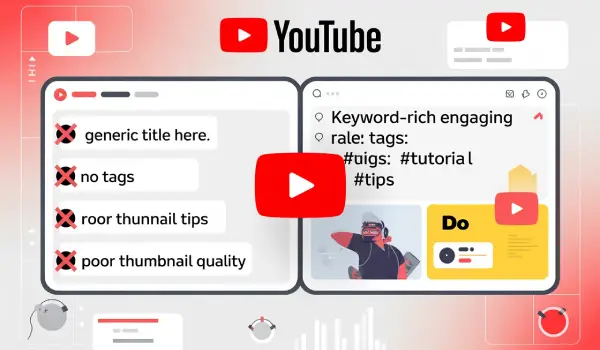
Common YouTube SEO Mistakes
Mistake 1
Keyword stuffing Cramming keywords everywhere makes your content look spammy and turns viewers away.
Mistake 2
Ignoring the first 48 hours When you first upload, engage heavily. Respond to comments, share the video, and monitor its performance. The first 48 hours are crucial for YouTube’s algorithm.
Mistake 3
Buying views or subscribers This violates YouTube’s terms and can get your channel terminated. All those fake numbers help nothing anyway since fake accounts don’t watch your videos.
Mistake 4
Making videos too long Longer isn’t always better. Match your video length to your content. A 3-minute video that keeps people engaged beats a 20-minute video people abandon.
Mistake 5
Neglecting older videos Update descriptions and titles of older videos if they’re not performing. Sometimes a small tweak can breathe new life into old content.
Tools That Help
You don’t need expensive tools, but some free ones help with YouTube SEO:
TubeBuddy: Browser extension that helps with keyword research, tags, and optimization.
VidIQ: Similar to TubeBuddy, offers insights about your videos and competitors.
YouTube Analytics: Built right into YouTube, this is your most important tool. Learn to read it well.
Google Trends: See what topics are trending and when interest peaks.
Canva: Free thumbnail creation with templates.
Mobile Optimization Matters
Over 70% of YouTube watch time comes from mobile devices. This means:
Make thumbnails readable on small screens: Test how your thumbnail looks on a phone.
Keep videos engaging: People watching on phones are easily distracted.
Use vertical video when appropriate: For certain content types, vertical format works better on mobile.
Check your description formatting: Make sure it’s readable on mobile where space is limited.
Building Your Channel Authority
Beyond individual video optimization, building overall channel authority helps everything you post. Here’s how:
Complete your channel profile: Add a channel description, banner image, and profile picture.
Create a channel trailer: Make a short video welcoming new visitors and explaining what your channel offers.
Organize with sections: Use channel sections to highlight your best content and playlists.
Link your social media: Add links to your other platforms in your channel description.
Post community updates: Keep your audience engaged between video uploads.
Respond to all comments: At least in the first few days after uploading. This shows you value your community.
Understanding Your Audience
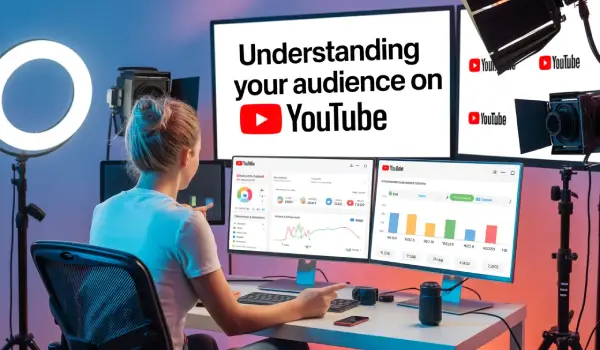
The better you know who watches your videos, the better you can optimize for them. YouTube SEO isn’t just about algorithms. It’s about matching the right content with the right people.
Check your YouTube Analytics demographics section to learn:
- Age and gender of your viewers
- Geographic location
- What devices they use
- When they’re most active
Use this information to:
- Make content that appeals to your actual audience
- Upload when they’re most likely to be online
- Use language and references they’ll understand
- Create thumbnails that appeal to their preferences
Collaborations and Guest Appearances
Working with other creators introduces your channel to new audiences. When collaborating:
Choose relevant partners: Find creators in your niche with similar audience sizes.
Provide value: Make sure the collaboration benefits both channels.
Cross-promote properly: Mention and link to each other’s channels clearly.
Create genuinely good content: Don’t let the collaboration be a lazy cash grab. Make something valuable.
Collaborations boost your YouTube SEO indirectly by bringing new subscribers who watch multiple videos, sending positive signals to YouTube.
Creating Series and Multi Part Content
Series keep viewers coming back, which YouTube loves. When viewers watch multiple related videos, it shows strong interest in your content.
How to create effective series:
Make each video valuable alone: People should get value even if they only watch one episode.
Build anticipation: Tease what’s coming in the next episode.
Use consistent naming: “Cookie Basics: Episode 1,” “Cookie Basics: Episode 2,” etc.
Link them together: Use cards, end screens, and playlists to connect series videos.
Staying Updated
YouTube changes its algorithm regularly. What works today might work differently next year. Stay informed by:
Following YouTube’s Creator Insider channel: They share official updates and insights.
Joining creator communities: Learn from others’ experiences.
Testing and learning: Try new approaches and measure results.
Reading YouTube’s official blog: They announce major changes there.
Don’t chase every trend or algorithm change frantically. Focus on making quality content for your audience, and adapt gradually as you learn what works.
Conclusion
YouTube SEO in 2026 comes down to one core principle: help YouTube help you. When you make it easy for YouTube to understand your content, and when you create videos people genuinely want to watch, the algorithm works in your favor.
Start with the basics: great titles, detailed descriptions, relevant tags, eye-catching thumbnails, and quality content. Master these fundamentals before worrying about advanced tactics.
Remember that growth takes time. Your first video probably won’t go viral. Your first month might bring just a handful of subscribers. That’s normal. Keep learning, keep improving, and keep creating.
The creators who succeed on YouTube aren’t always the most talented or the ones with the best equipment. They’re the ones who understand their audience, optimize their content properly, and persist long enough to break through.
Your YouTube journey starts with your next video. Apply what you’ve learned here, measure your results, and keep improving. With patience and proper optimization, you can build a successful YouTube channel that reaches the exact audience you want to serve.
Now stop reading and start creating. Your future viewers are out there searching for content exactly like yours. Make it easy for them to find you.